


RNGC Course Background
The Royal Nairobi Golf Club is Kenya’s oldest surviving golf society, founded in 1906. Originally a 9-hole course with sand greens, it was expanded into a fully grassed 18-hole course in the 1920s. In its early days, wildlife roamed freely across the course, including a marauding leopard that was shot there in 1919.
Originally known as the Nairobi Golf Club, the Club hosted the first East African Ladies’ Championship in 1932 under the auspices of the Kenya Golf Union. Three years later, during the Jubilee Year, King George V granted the Club Royal patronage, giving rise to the name it bears today.
The Club was established initially as a recreational amenity for officers of the King’s African Rifles, the precursor to the Kenyan Army. It was the third golf club founded in British East Africa, as Kenya was then known. The two clubs established earlier, in 1902 and 1905, no longer exist, making Royal Nairobi Golf Club the oldest surviving golf club in the country.
A third nine holes was added in 1954 and remained in use until 1971, when the land was sold back to the municipal authorities for housing development. A fairway irrigation system was installed the following year, while the greens were replanted in 1984.
Traditionally, Royal Nairobi Golf Club was a colonial-era golf course. However, as the game, equipment and playing standards have evolved, successive Course Committees have made improvements and modifications to ensure the course continues to meet the demands of modern golf.
The Course Today

Number 2 green and 3 tee box water features are as much for beauty as they are for play.
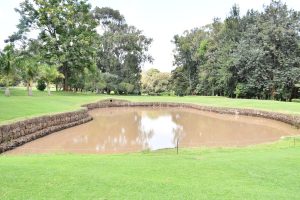
Number 13 pond makes playing the hole a rewarding challenge.

Number 3 green water features lie silently in wait for the overshoot.
Today, Royal Nairobi Golf Club boasts an 18-hole championship golf course measuring more than 7,200 yards from the back tees, with a par of 72 and an established slope rating.
The two nines are relatively flat but present distinctly different challenges, owing in part to the contrasting soil structures across the course. Its principal defenses are its length and a number of strategically positioned water features introduced over the years.
Among the most significant developments is the large dam situated between holes 15 and 16. Beyond adding considerable challenge to these holes, the dam also serves an important practical purpose by increasing the water available for course irrigation.
The par-3 holes are generally demanding, while the closing stretch of 16, 17 and 18 provides a fitting examination of nerve, accuracy and course management—making the finish worthy of any championship.
At Royal Nairobi Golf Club, history is woven into the fairways, but the course continues to evolve with the game.